
Municipal waste fleets rarely fail because of poor route planning alone; more often, procurement teams lock into the wrong vehicle type or under-specify the compaction body to meet a tight capital budget. Across 4 m³ to 20 m³ waste collection trucks, the gap between an entry-level rear loader and a heavy-duty high-compaction unit comes down to steel abrasion resistance, hydraulic cylinder and valve quality, bin-lifter complexity, and leachate sealing.
Comparing a garbage compactor truck against a skip loader truck or a hook lift truck also changes how capital is split between truck chassis and steel containers. Before requesting formal bids, fleet buyers should map both the upfront truck price and the cost per tonne of refuse hauled over five to seven years.
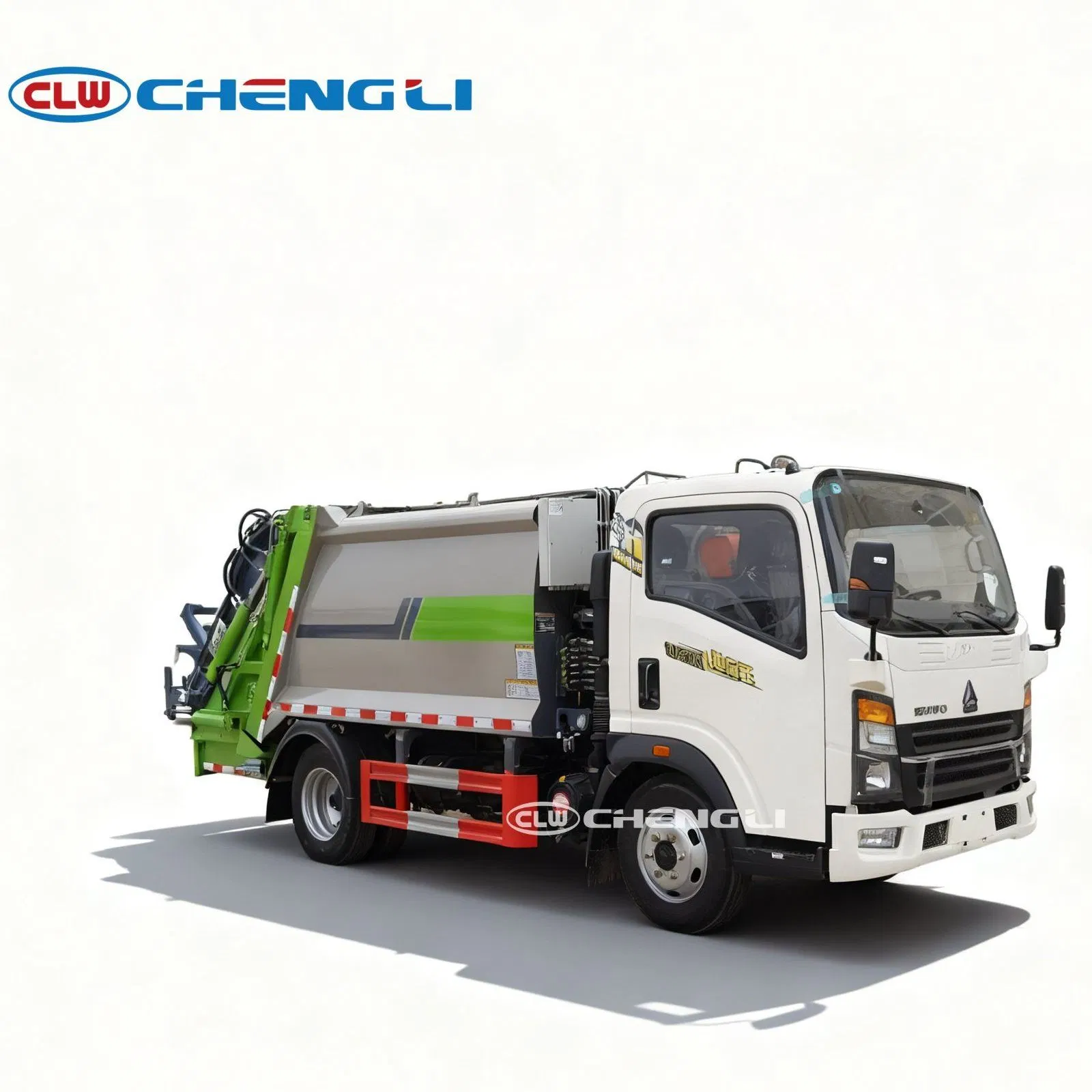
Compactor Capacity Tiers From 4 m³ to 20 m³
Compact 4 m³ to 6 m³ rear loaders—such as our HOWO compact garbage compactor truck—mount on narrow 4x2 light-duty chassis designed for historic city centres, gated estates, and steep residential alleys. Moving to 8 m³ to 12 m³ medium-duty 4x2 compactors—like our medium-capacity rear loader compactor—delivers the best balance of purchase price and daily kerbside tonnage for most secondary cities.
Heavy municipal districts and long hauls to distant landfills justify 14 m³ to 20 m³ 6x4 compactors. While a 18–20 m³ 6x4 rear loader costs roughly 2.1x to 2.7x as much as a 5 m³ light unit, its higher compaction ratio (typically 2.5:1 to 3:1 on household waste) cuts landfill round trips in half and lowers fuel and driver cost per tonne.
Compactor Body Volume | Typical Chassis Layout | Relative Price Tier | Typical Payload & Route Fit |
|---|---|---|---|
4 – 6 m³ | 4x2 light-duty | Entry (1.0x baseline) | 2.5 – 4 tonnes; narrow alleys, resorts, residential estates |
8 – 12 m³ | 4x2 medium-heavy | Mid (1.4x – 1.8x) | 5 – 8 tonnes; standard kerbside municipal routes |
14 – 16 m³ | 4x2 heavy / 6x4 | Upper-Mid (1.9x – 2.3x) | 9 – 11 tonnes; high-density urban corridors |
18 – 20 m³ | 6x4 heavy-duty | Heavy (2.3x – 2.8x) | 12 – 15 tonnes; transfer-free long hauls to landfill |
Compactor vs Skip Loader vs Hook Lift Budget Structure
Many buyers ask why a 10 m³ rear-loader compactor costs noticeably more per truck than a swing-arm skip loader truck or a detachable-body JAC hook lift truck on the same chassis. The reason is that a rear loader integrates a curved high-strength body, an ejection blade, a heavy tailgate with slide and sweep compaction cylinders, a PLC control box, and a hydraulic bin lifter—all permanently welded to one truck.
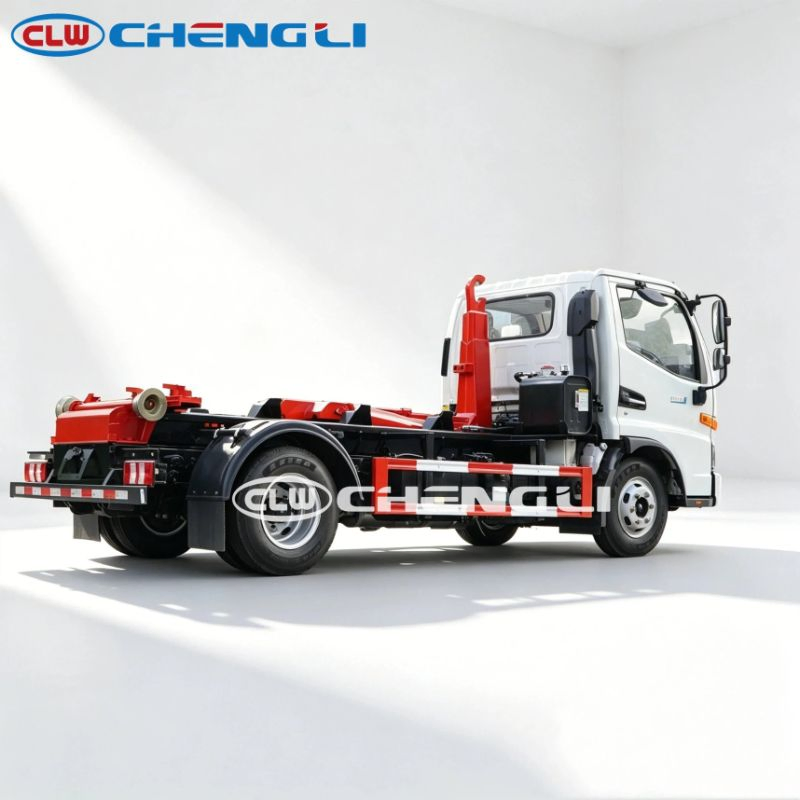
A skip loader (such as our swing-arm skip loader configuration) or a roll-on/roll-off hook lift—often called an arm roll truck in Southeast Asia—has a simpler, lighter hydraulic frame on the truck itself, so the single-truck price is typically 15% to 30% lower than a same-chassis compactor. However, the real system budget must include the detachable skip bins or roll-off containers (commonly 4 to 10 bins per truck). For heavy 6x4 transfer operations, a heavy Dongfeng hook lift truck paired with sealed transfer boxes often beats multiple compactors on total fleet cost. Our operational comparison of compactor vs skip loader vs hook lift trucks explains when each system wins.
Wet organic waste from markets and restaurants introduces another niche: a dedicated food waste truck—like our Dongfeng food waste collection truck—adds solid-liquid separation screens, a stainless-steel tank or sealed drum, and an optional high-pressure bin washer, placing it roughly 10% to 20% above a standard dry-refuse rear loader of similar size.
Upper-Body Cost Drivers Inside a Rear Loader
Two 12 m³ rear-loader quotes can look identical in photos while hiding major durability differences. First is steel grade and thickness: economy bodies use Q235B mild steel throughout, which wears through quickly on abrasive construction debris or wet organic leachate. Upgrading the hopper floor and curved body plates to Q345B (T420) manganese steel—or Hardox/NM400 wear-resistant plate in the tailgate hopper—raises upper-body cost by 10% to 22% but doubles floor service life.
Second is the hydraulic and control package. Standard Chinese gear pumps, manual-plus-electric multi-way valves, and PLC/CAN-bus control panels are reliable and easy to repair anywhere in Africa or South Asia. Specifying European hydraulic valves, dual-pump fast-cycle circuits, or automated pressure-boost valves adds 12% to 25% to the upper body. Third is the rear loading mechanism: a universal comb lifter for 120 L / 240 L plastic wheelie bins is standard; adding a heavy trunnion arm for 660 L / 1,100 L steel dumpsters, a ground-level scoop shovel, or a sealed pendulum cover adds incremental hardware and cylinder cost.
Specification Option | Effect on Complete Truck Price | Operational Payoff | When to Specify |
|---|---|---|---|
Q345B / NM400 wear-plate hopper | +4% to +9% | Prevents premature hopper rust-through and abrasion | Wet household waste, coastal humidity, mixed debris |
Dual-mode lifter (240 L + 1,100 L) | +3% to +6% | Handles both residential wheelie bins and commercial skips | Mixed urban and commercial city sanitation routes |
Rear-view camera + CAN-bus diagnostics | +1% to +3% | Faster troubleshooting and safer kerbside reversing | All municipal fleets with multi-shift drivers |
Stainless-steel sewage tank & EPDM seal | +2% to +5% | Stops foul leachate dripping on city streets | Tropical climates and high-moisture organic refuse |
Chassis Selection and Fleet Standardisation
Because waste trucks run stop-start urban cycles with high PTO hours, clutch, brake, and cooling reliability matter more than highway top speed. Dongfeng special trucks and Sinotruk HOWO special trucks lead export municipal tenders for 8 m³ to 20 m³ compactors due to competitive pricing and broad parts availability. For smaller 4 m³ to 8 m³ urban units, Isuzu special trucks and Foton special trucks are popular where tight turning circles and driver familiarity drive tender scoring, while Shacman special trucks are widely chosen for heavy 6x4 transfer hook lifts.
When budgeting a multi-truck sanitation contract—often combining compactors with a sewage suction truck like our Shacman sewage suction truck—standardising on one chassis brand and one emission tier cuts spare-parts inventory cost by 20% to 30% over the contract term.
Shipping Volume, Spare Parts and Lifecycle Costs
Rear-loader compactors are tall, boxy vehicles, so ocean freight on Ro-Ro vessels represents a meaningful share of landed cost. A 10 m³ compactor typically occupies 55 to 68 CBM, while an 18–20 m³ 6x4 unit can exceed 85 CBM. If you are ordering skip loaders or hook lifts alongside extra bins, nesting the steel skip bins inside each other—or shipping bins inside a 40 ft high-cube container while the trucks travel Ro-Ro—often trims total freight significantly. Review our FOB vs CFR vs CIF guide and shipping and delivery procedures to structure freight efficiently.
Do not overlook commissioning spares: budgeting 3% to 5% of vehicle FOB value for spare cylinder seal kits, proximity switches, tailgate rubber sealing strips, hydraulic filters, and PTO cables under our warranty and spare parts programme avoids idle trucks during peak collection seasons. Every unit undergoes full compaction-cycle and hydraulic-pressure verification under factory quality control prior to dispatch.
Common Questions About Garbage Compactor Truck Pricing
Does a higher compaction ratio cost more upfront?
Yes. Achieving a true 2.5:1 to 3:1 compaction ratio requires thicker curved side walls, heavier slide-plate wear pads, larger-bore cylinders, and higher hydraulic working pressure (typically 18–20 MPa), which increases fabrication cost compared with light-duty low-compression bodies.
Are skip bins or hook-lift containers included in the truck price?
Usually one standard bin is quoted with a skip loader or hook lift unless the buyer specifies otherwise. Extra bins are priced per unit based on cubic capacity (typically 3 m³ to 20 m³), steel plate thickness, and whether sealed lids are required.
Should we specify an automatic transmission for a garbage compactor?
An Allison or heavy-duty AMT gearbox adds roughly 10% to 18% to chassis cost, so it is uncommon on budget-constrained tenders. However, on dense kerbside routes with hundreds of daily stops, it eliminates frequent clutch replacements and can lower five-year operating cost.
How can we keep landed costs down on a multi-unit municipal tender?
Match body volume accurately to route road width, standardise on one chassis OEM and one bin-lifter interface, confirm local emission rules early, and book consolidated Ro-Ro or bulk-vessel space through our order workflow.
Preparing a municipal sanitation budget or private waste-hauling fleet expansion? Explore our full truck catalogue, review more cost breakdowns in our price guides, or request an itemised factory quotation via get a quote or contact our export engineers.
Discuss your truck requirement
Share your working task and destination with the CLW team.
Build Your Enquiry