
Choosing the wrong waste-collection body is one of the fastest ways to blow a municipal fleet budget. A garbage compactor truck can reduce the number of disposal trips on suitable routes; the cost benefit depends on waste density, payload and haul distance, whereas a skip loader truck handles open public markets and narrow alleys with far simpler hydraulics. If one prime chassis needs to cycle between ten or more heavy containers at a transfer station or demolition site, a hook lift truck can serve a pool of compatible detachable containers. And where restaurants or wet markets generate acidic, high-moisture organics, a correctly specified, sealed corrosion-resistant food waste collection truck helps manage corrosion and leachate risks.
This guide compares body mechanisms and the information a buyer should confirm before requesting a quotation. Treat the example ranges as planning references, not a guarantee that every chassis, capacity or equipment combination is available.
How the Four Waste Truck Types Compare
Before looking at chassis brands or engine horsepower, match the upper-body mechanism to the type of waste and how bins are staged along your route. Review the four configurations within the waste collection trucks line:
Specification | Garbage Compactor (Rear Loader) | Skip Loader (Swing-Arm) | Hook Lift (Arm Roll / Roll-Off) | Food Waste Truck |
|---|---|---|---|---|
Body / Container Volume | 4 m³ – 20 m³ | 3 m³ – 10 m³ skips | 5 m³ – 20 m³ containers | 5 m³ – 12 m³ sealed tank |
Compaction Ratio | 2.5:1 to 3.5:1 | 1:1 (loose load) | 1:1 (or mobile compactor box) | 1:1 with solid–liquid separation |
Best Fit | Kerbside residential & commercial bins (120L / 240L / 660L / 1,100L) | Public markets, housing estates, narrow urban collection points | Transfer stations, industrial parks, scrap & demolition haulage | Hotels, restaurants, canteens & wet food markets |
One Chassis, Multiple Compatible Containers | No (fixed body) | Yes; size the skip pool to the route | Yes; size the container pool to the route | No (empties sealed 120L/240L bins) |
Typical Crew | 1 driver + 1–2 loaders | 1 driver | 1 driver (in-cab controls) | 1 driver + 1 loader |
Hydraulic Complexity | Medium–High | Low (easy local servicing) | Medium | Medium |
Common Chassis | Foton, Isuzu, Dongfeng, HOWO | Foton, Isuzu, Dongfeng, JAC | Isuzu, Dongfeng, HOWO, Shacman | Foton, Isuzu, Dongfeng |
Matching the Body Type to Your Collection Route
Garbage Compactor Trucks (Rear Loaders)
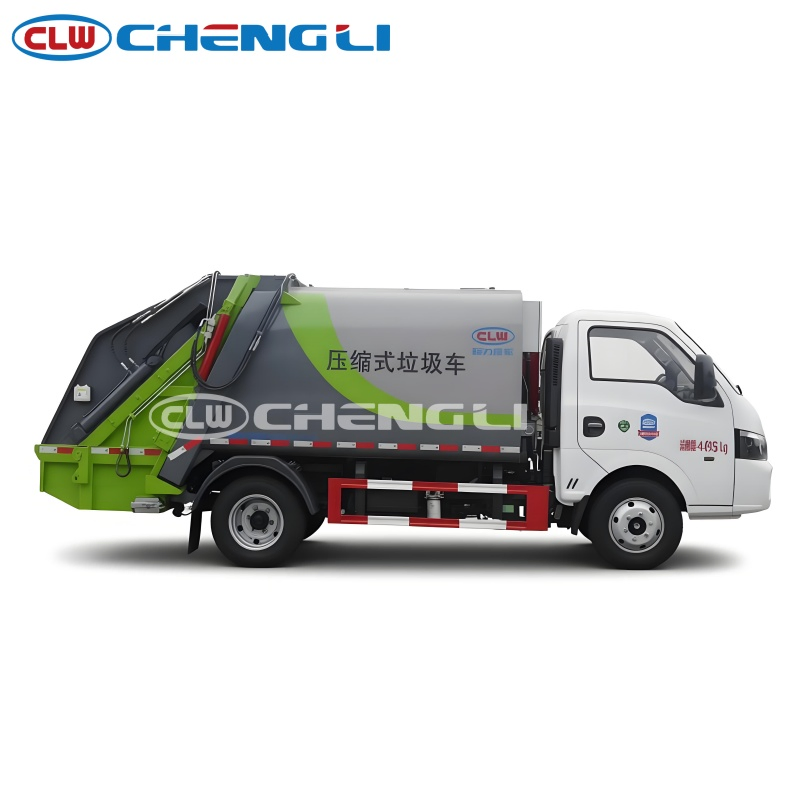
Rear-loader compactor body and rear loading mechanism. Product catalogue reference; equipment varies by model. View this product
A rear loader compresses loose refuse inside an enclosed body. Its useful load depends on waste composition, body capacity, chassis payload and axle limits. Compare actual weighed loads and route times before estimating how many disposal trips or vehicles compaction could save.
Compactors work best where cities already use standardised 240 L, 660 L or 1,100 L wheelie bins and where rainy-season leachate sealing matters. For tight inner-city streets, our compact HOWO 4×2 BLT5040ZYSZ6 Garbage Compactor Truck manoeuvres easily around parked traffic, while larger municipal districts typically step up to a higher-payload unit like the 4×2 194 hp Garbage Compactor Truck.
Skip Loader Trucks (Swing-Arm)
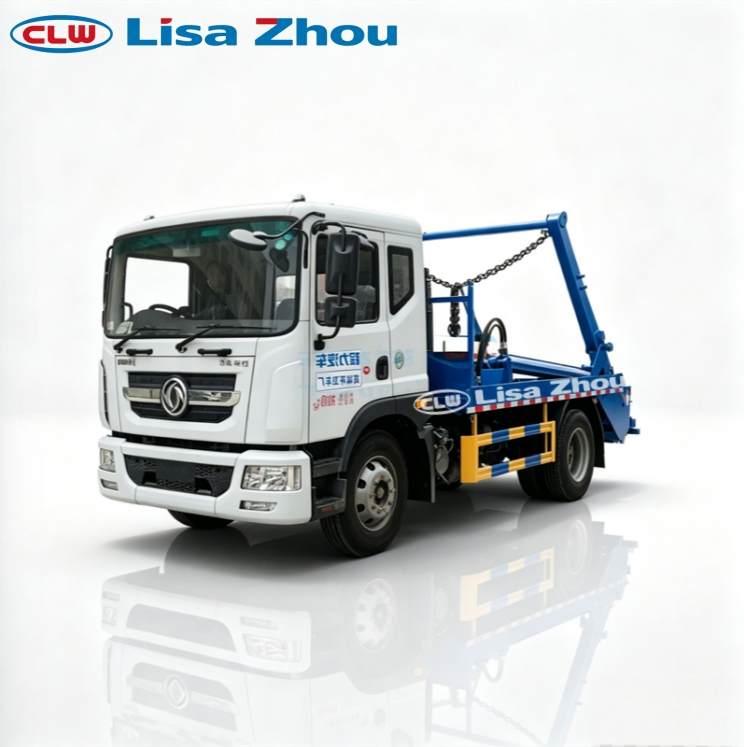
Twin lifting arms and chains on a skip-loader chassis. Product catalogue reference; equipment varies by model. View this product
Widely known as a swing-arm skip truck across Africa, the Middle East and South Asia, a skip loader uses twin hydraulic arms and lifting chains to pick up, haul and tip 3 m³ to 10 m³ open or lidded skips. Because there is no compaction blade or complex sensor array, local mechanics can service the cylinders and hoses with standard workshop tools.
Skip loaders shine in neighbourhoods without household wheelie bins—public markets, residential compounds and construction drop points where one truck rotates across a dozen ground skips. Buyers serving narrow market alleys often start with the CL BZW 4×2 Skip Loader Truck, while heavier municipal transfer routes favour the 11,185 kg Heavy-Duty Skip Loader Truck.
Hook Lift Trucks (Arm Roll / Roll-Off)
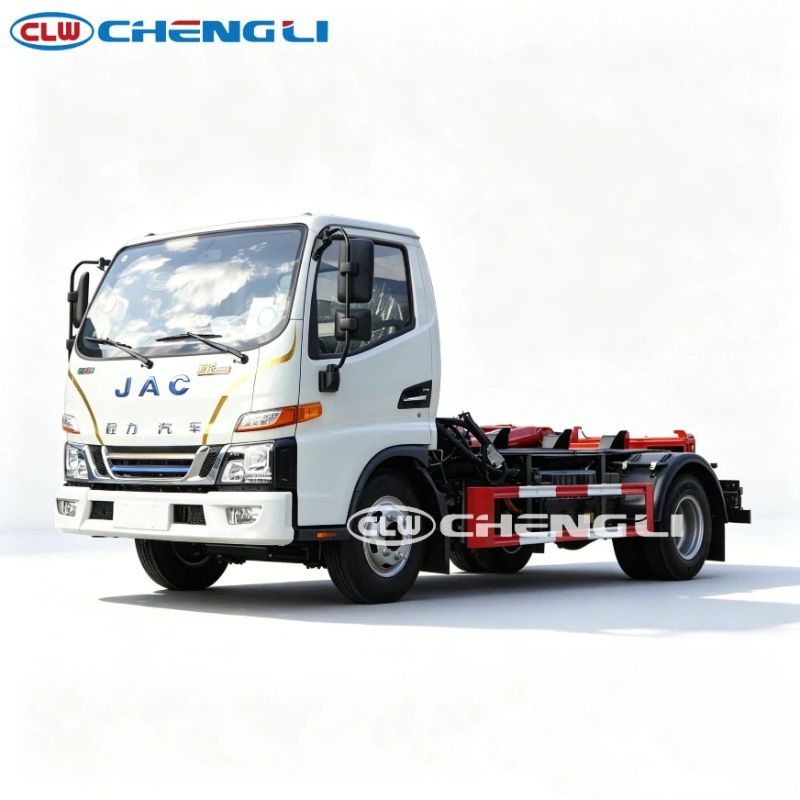
JAC hook-lift chassis with a central hydraulic arm. Product catalogue reference; equipment varies by model. View this product
Called an arm roll truck in Malaysia, Singapore and Indonesia—and a roll-off truck in most international tenders—a hook lift pulls detachable containers up to 20 m³ onto the chassis via a central hydraulic hook arm operated from inside the cab. Container exchange time depends on the equipment, container load, ground conditions and operator procedure; confirm the sequence and safe operating requirements for the selected model.
The real financial advantage is fleet flexibility: the same chassis can move a sealed municipal refuse container in the morning, an open demolition bin at midday and a mobile compactor container for a shopping centre in the afternoon. For medium urban swaps, see the JAC 4×2 12-Ton Hook Lift Truck; for heavy transfer-station haulage above 10 tonnes, look at the Dongfeng 6×4 CL5320ZXXBEV Hook Lift Truck.
Food Waste Collection Trucks
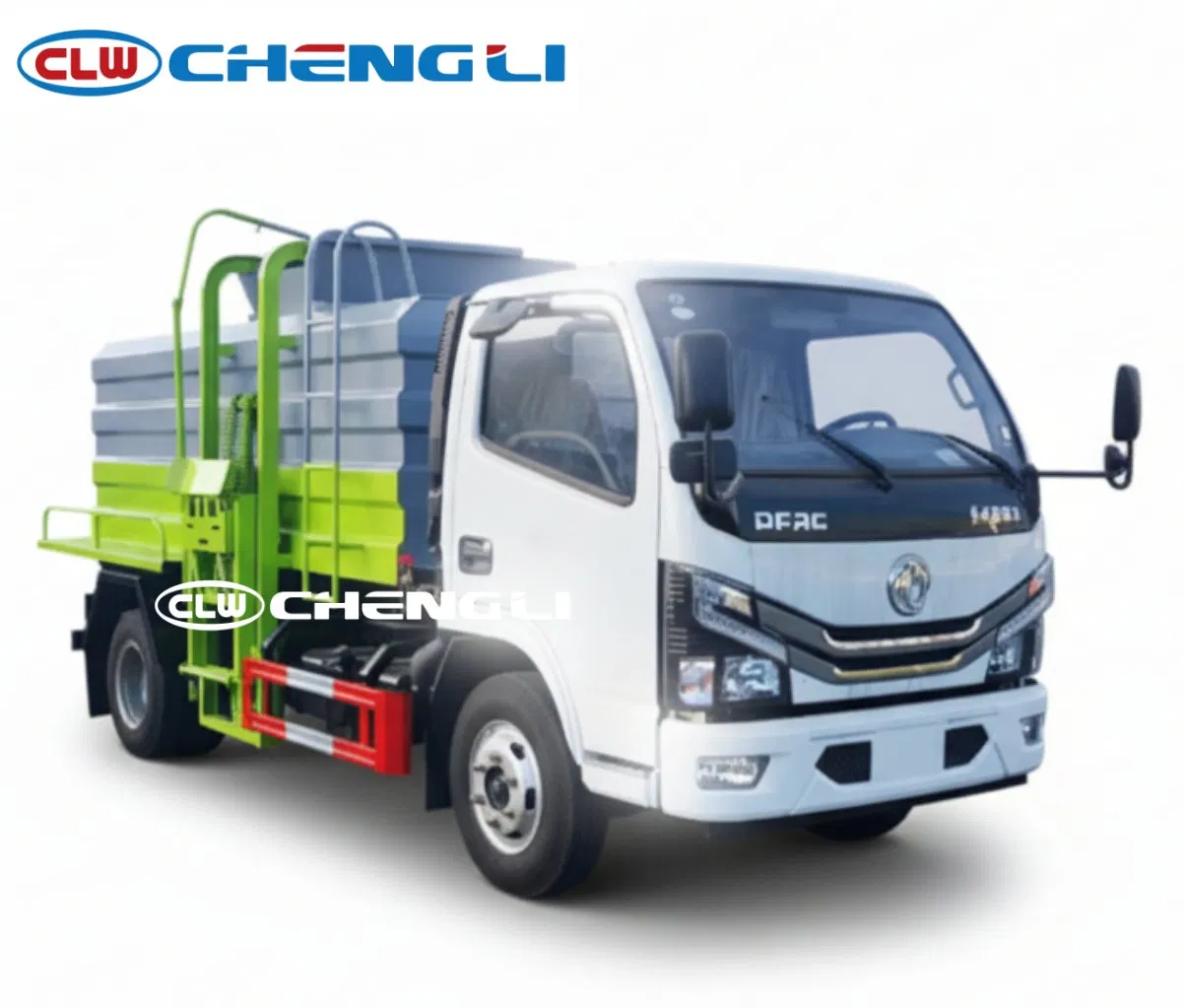
Enclosed food-waste body with side bin-lifting equipment. Product catalogue reference; equipment varies by model. View this product
Wet, salty food waste calls for a body material, seals and discharge arrangement suited to the collected material. Depending on the selected model, options may include a corrosion-resistant body, side bin lifter and solid–liquid separation. Confirm the exact material grade and equipment in the quotation. For commercial dining districts, compare the Dongfeng 4×2 CLW5180TCAD6 Food Waste Collection Truck with the more compact 4×2 CL5042TCA6CC Food Waste Collection Truck.
Sizing Your Fleet Capacity Without Overbuying
Buyers often either oversize a chassis—triggering axle-load penalties and tight-street access problems—or buy too small and burn excess diesel making extra landfill runs. A simple field formula gives a reliable starting figure:
Daily Waste Volume (m³) = (Population Served × Daily Waste per Capita in kg) ÷ Loose Waste Density (kg/m³)
For an initial scenario only, waste generation averages 0.55 to 0.85 kg per person per day (rising to 1.0–1.4 kg in commercial centres). Loose household waste weighs roughly 220–300 kg/m³ (up to 400 kg/m³ in wet-market zones), whereas compacted waste inside a CLW rear loader reaches 650–800 kg/m³.
Take a municipality serving 50,000 residents generating about 35 tonnes of refuse a day:
Running 12 m³ compactors (~8 tonnes per compacted load × 2 trips per shift = 16 tonnes/day each), you need 3 active trucks plus 1 standby unit to cover scheduled servicing without missed routes.
Running 6 m³ non-compacting skip loaders (~1.8 tonnes per loose skip × 4 swaps per day = 7.2 tonnes/day each), the same district requires 5 to 6 active trucks along with 30 to 50 ground skips.
When landfill distance is long, compactors almost always deliver the lower cost per tonne. When routes are short and mixed with heavy construction debris, skip loaders or hook lifts avoid premature packer-blade wear. (If you want quick definitions of GVW, PTO or compaction ratio, browse our Special Truck Glossary.)
Chassis, Drive Layout and Emission Choices That Affect Uptime
The upper body does the collection work, but the chassis determines spare-parts availability, driver familiarity and resale value in your local market. CLW mounts upper bodies on eight commercial chassis platforms—you can compare the full line-up on our Chassis Overview:
Chassis Platform | Typical Body Range | Practical Strength | Where Buyers Prefer It |
|---|---|---|---|
4–14 m³ (4×2) | Low fuel burn, nimble urban turning, wide dealer parts stock | East & Southern Africa (RHD), Southeast Asia, Middle East, Caribbean | |
10–20 m³ | Heavy axles, high payload margin, widely stocked affordable parts | West & East Africa, Middle East, Central Asia, South Asia | |
5–18 m³ | Balanced purchase price and durability, Cummins/Yuchai options | Africa, Southeast Asia, South America, Middle East | |
14–20+ m³ (6×4) | Weichai + Fast gearbox + Hande axles built for rough landfill tracks | Mining towns, West Africa, Central Asia, Pacific | |
3–12 m³ (4×2) | Tight wheelbase and economical entry cost for narrow city lanes | Urban Southeast Asia, South Asia, smaller municipalities |
For paved urban routes up to 12 m³, a 4×2 drive layout keeps tyre and fuel costs down. Once gross vehicle weight passes 18 tonnes—or when trucks must climb muddy, unpaved landfill ramps—step up to a 6×4. For remote mining camps or flood-prone rural districts where highway axles bog down, CLW also builds sanitation and utility bodies on 4×4 & 6×6 off-road trucks.
Select the engine and after-treatment system only after checking the destination registration requirements, available fuel quality and local service support. Confirm the proposed emissions configuration and supporting documents for the specific chassis; a regional guide is not an import-approval determination.
Regional Steering and Compliance Notes (LHD vs. RHD)
Confirm steering hand and pre-shipment inspection rules early so chassis allocation does not delay production:
Region | Representative Countries | Steering | Typical Fleet Specification |
|---|---|---|---|
Africa (West) | Nigeria, Ghana, Cameroon, Sierra Leone | LHD | 12–20 m³ HOWO/Dongfeng compactors, Euro II/III, heavy leaf springs |
Africa (East & Southern) | Kenya, Tanzania, Uganda, Zambia, Zimbabwe, South Africa | RHD | Isuzu & HOWO compactors, skip loaders, exhauster trucks; confirm the applicable inspection and documentation requirements |
Southeast Asia (RHD) | Malaysia, Singapore, Indonesia, Thailand | RHD | Hook lift (arm roll) & food waste trucks, Euro IV/V, compact turning radius |
Southeast Asia (LHD) | Philippines, Vietnam, Cambodia | LHD | 6–14 m³ compactors, Isuzu/Dongfeng chassis, marine-grade anti-corrosion coat |
Pakistan, Bangladesh, Sri Lanka, Nepal | RHD | 5–12 m³ compactors & skip loaders sized for narrow city streets | |
UAE, Saudi Arabia, Qatar, Oman, Iraq | LHD | 50 °C tropicalised cooling & A/C, heavy dust filtration, Euro IV/V |
Pairing Solid-Waste Trucks with Liquid-Waste and Road-Cleaning Units
Most city authorities and urban service contractors procure solid-waste trucks alongside liquid-waste, road-cleaning and civil-support units. You can review complete sector packages on our City Services & Sanitation and Mining & Quarrying pages, or combine models directly from CLW's municipal sanitation trucks range:
For septic-tank and pit-latrine emptying, fleets rely on a sewage suction truck (commonly called an exhauster truck or honey sucker)—for instance, our Shacman 15,000 L Sewage Suction Truck. Where blocked storm culverts need high-pressure water jetting alongside sludge suction, a sewer jetting & vacuum combination truck such as the Dongfeng 4×2 8,000 L Combination Unit handles both jobs in one visit.
For arterial road maintenance, municipalities pair dry road sweeper trucks (like the Dongfeng 7,000 L Road Sweeper Truck) with high-pressure washing & sweeping trucks such as the CL5180 Washing & Sweeping Truck, backed up by water tanker trucks (water bowsers, e.g., the Dongfeng 12,500 L Water Tanker Truck) for street washing and landscaping, plus dust suppression trucks (fog cannon trucks like the Foton 4×2 10t Dust Suppression Truck) around quarries, ports and demolition zones.
Finally, larger depots and landfill operators typically add tipper trucks (such as the 6×4 340 hp 20,450 L Tipper Truck) for cover soil and rubble, a truck mounted crane for moving heavy street containers or municipal gear, and a fuel bowser truck (like the Dongfeng 4×2 Mobile Refueller) so vehicles refuel at the yard rather than queuing at public stations.
Small Specification Details Worth Confirming Before Production
When reviewing a factory quotation, a few line items make a disproportionate difference after the truck arrives in service:
Bin-lifter compatibility: Confirm whether your city uses 120 L / 240 L / 660 L / 1,100 L EN840 bins, triangular buckets or steel skips—mismatched lifters slow down every shift.
Body steel grade: Ask for the proposed body steel grade, thickness and corrosion protection for the intended material and duty cycle; agree these values against the selected design rather than applying one thickness to every truck.
Leachate sealing & drainage: Check for dual rubber tailgate seals, hydraulic locking hooks and accessible ball-valve drains.
Hydraulic spares & cooling: Request documented pump/valve specs plus a one-year wearing-parts kit shipped in the cab (see our Warranty & Spare Parts support), and specify an oversized hydraulic oil cooler via Customization & OEM if ambient temperatures exceed 45 °C.
Factory inspection & shipping height: Agree the required hydraulic, body-operation and road checks with reference to the Quality Control programme. Confirm overall height early so we can optimise freight between RoRo and Flat Rack vessels (detailed on Shipping & Delivery, along with our Import & Shipping and Price Guides sections).
Common Questions from Fleet Buyers
What is the main difference between a skip loader and a hook lift truck?
A skip loader uses twin side swing arms and chains to lift 3–10 m³ skips vertically onto the deck—simple, compact and ideal for tight urban markets. A hook lift uses a single central hydraulic arm to pull larger 5–20 m³ containers from the rear, offering higher payload and solo in-cab operation.
Can one garbage compactor truck lift both 240 L and 1,100 L bins?
Yes. CLW rear loaders can be fitted with a combination bin-lifter frame that handles twin 240 L plastic wheelie bins as well as single 660 L or 1,100 L four-wheel containers without swapping attachments.
Which chassis brand is easiest to maintain in Africa or Southeast Asia?
Always follow your local spare-parts network. Across East/Southern Africa and Southeast Asia, Isuzu and Dongfeng are widely supported for 4×2 urban trucks, while Sinotruk HOWO and Shacman are the standard choice for heavy 6×4 fleets (14–20 m³) because axles, clutches and filters are stocked almost everywhere.
Do you build Right-Hand Drive (RHD) waste and sanitation trucks?
LHD or RHD availability depends on the chosen chassis and body combination. State the destination and steering requirement at enquiry stage, then confirm the exact chassis, emissions configuration and documentation before ordering.
How long does production take, and can we inspect before shipping?
Production timing depends on chassis availability, specification approval, equipment and the agreed inspection scope. Request a written schedule with the quotation. If third-party inspection or test photographs and videos are required, agree the organisation, scope and timing before placing the order.
If you are comparing body types or sizing a new municipal tender, send our engineers your target country, daily tonnage, preferred chassis and LHD/RHD requirement. You can browse all 35+ truck types in the CLW Products Catalogue, download PDF datasheets from Spec Sheet Downloads, or review the available information in Delivery Cases and Buying Guides. For a tailored specification and a quotation based on the agreed scope and shipping terms, request a factory-direct quote or reach us via Contact CLW.
Discuss your truck requirement
Share your working task and destination with the CLW team.
Build Your Enquiry