
Specifying commercial and municipal trucks for Nigeria and Ghana starts with accepting what happens once a vehicle rolls out of Apapa, Tin Can Island, or Tema port. On paper, a standard highway chassis from China looks adequate for Lagos refuse routes or Kumasi fuel deliveries. In daily service, broken bitumen, long queues at depot gates, high-sulphur diesel, and humid coastal salt air punish under-specified components within six months. Fleet managers who have operated in West Africa for years rarely buy off-the-shelf catalogue builds; they adjust axle ratings, fuel filtration, suspension packs, and body steel thickness before the truck ever leaves Hubei.
Both Nigeria and Ghana are left-hand-drive (LHD) markets with strict port compliance frameworks and distinct operational habits. Across African special truck markets, West Africa stands out for heavy stop-start urban congestion in Lagos, Port Harcourt, and Accra alongside long, corrugated intercity haulage toward Kano, Abuja, and Tamale. Matching chassis mechanics and upper-body hydraulics to those realities saves far more money over a five-year lifecycle than chasing the lowest FOB quote.
Road Conditions, Diesel Sulphur, and LHD Chassis Selection
Emission standard selection is the single most common specification mistake in West Africa. High-pressure common-rail Euro 5 or Euro 6 engines equipped with DPF and SCR aftertreatment struggle when refuelled at roadside stations where diesel sulphur levels remain elevated and water contamination is routine. For most municipal and contractor fleets in Nigeria and Ghana, mechanical-injection Euro 2 or robust Euro 3 diesel engines remain the practical benchmark because local mechanics can service injectors, fuel pumps, and turbochargers without proprietary diagnostic tablets.
When reviewing heavy-duty truck chassis options for LHD West African fleets, buyers tend to gravitate toward brands with deep aftermarket parts shelves in Ladipo Market (Lagos) or Abossey Okai (Accra). Sinotruk HOWO chassis and Shacman heavy-duty chassis dominate 6x4 and 8x4 vocational builds because leaf springs, hub-reduction axles, and Fast Gear transmissions are stocked locally. For medium-duty 4x2 municipal work—especially narrow residential collection or 10,000-litre bowsers—Dongfeng commercial chassis and FAW truck platforms offer lower kerb weight and straightforward electrical looms.
Chassis Component | Standard Highway Spec | Recommended Nigeria / Ghana Spec | Field Reason |
|---|---|---|---|
Emission & Fuel System | Euro 5 common-rail with single filter | Euro 2 / Euro 3 + dual Racor-style water separator | Tolerates high-sulphur diesel and depot sediment |
Rear Axle | Single-reduction 11-tonne highway axle | 13-tonne or 16-tonne hub-reduction axle | Handles overloaded dumps and unpaved feeder roads |
Suspension | Parabolic 3-leaf spring pack | Reinforced multi-leaf (10/12+9) with heavy U-bolts | Resists pothole shock and high-centre-of-gravity tanks |
Air Intake & Cooling | Dry paper filter, standard radiator | Oil-bath pre-cleaner + tropicalised copper/aluminium core | Protects against harmattan dust and traffic idling heat |
Refuse Collection Fleets: Compactors vs. Skip Loaders in Lagos and Accra
Urban sanitation operators serving PSP (Private Sector Participation) zones in Lagos or municipal assemblies in Greater Accra deal with wet, dense, organic-heavy waste mixed with sand and construction rubble. Standard light-gauge refuse bodies corrode along the hopper floor within eighteen months if leachate drains are undersized or mild steel is left untreated. Selecting the right configuration within our waste collection truck range depends on street width and landfill turnaround distance.
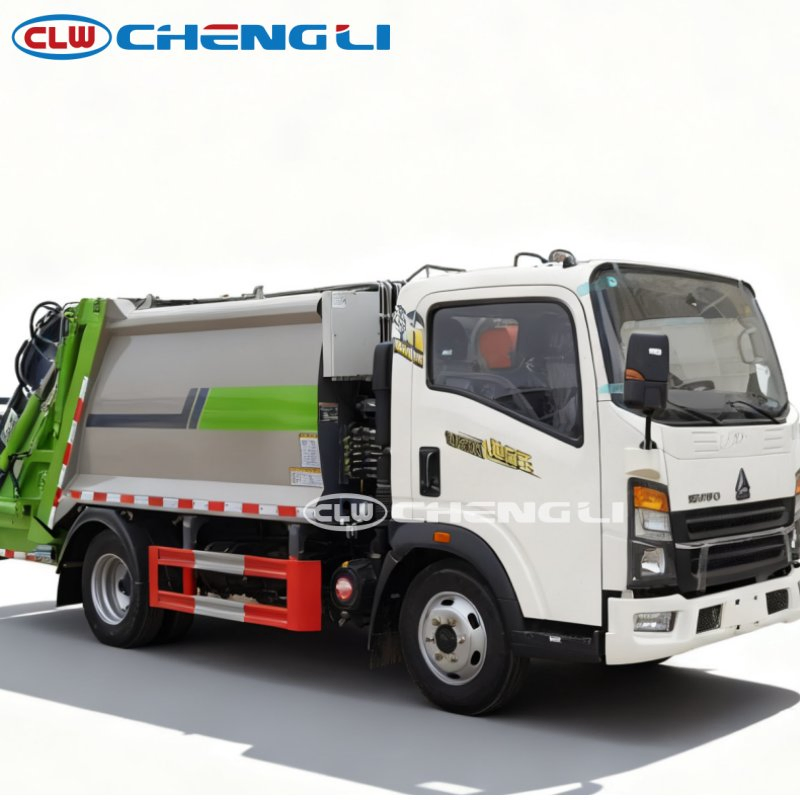
For high-density kerbside collection on paved corridors, a rear-loading garbage compactor truck—such as a 6 m³ to 18 m³ build or a compact HOWO rear-loader compactor—delivers high payload per trip to distant dumpsites like Olusosun or Kpone. We specify Q345 high-tensile steel or wear-resistant NM400 liner plates on the hopper floor, silicone-sealed tailgate gaskets, and dual sewage collection tanks so acidic leachate does not spill onto residential streets.
Where markets, mechanic villages, and informal settlements lack kerbside access, contractors pair compactors with a skip loader truck such as the CL-BZW swing-arm skip loader. One chassis services eight to twelve detached steel bins, allowing loading to happen while the truck is in transit. For fleets balancing both methods across municipal sanitation operations, our compactor, skip loader, and hook-lift comparison outlines payload economics and maintenance intervals.
Fuel Tankers, Mobile Bowsers, and Potable Water Distribution
Private depot haulage, telecom tower diesel refuelling, and construction site supply drive steady demand for our commercial tanker truck line across Nigeria and Ghana. On highways linking Apapa tank farms or Tema Oil Refinery to inland depots, a multi-compartment fuel tanker truck must be baffled cleanly to suppress liquid surge over broken expansion joints and steep ramps. Standard builds use 5 mm Q235 carbon steel shells with 6 mm dished ends, European-standard manhole covers, subsea emergency shut-off valves, and anti-static grounding reels.
For off-grid generator refuelling—telecom base stations, quarry plants, and estate power houses—buyers increasingly specify a self-dispensing fuel bowser truck like the Dongfeng 10,000–15,000 L mobile fuel bowser fitted with a PTO-driven gear pump, mechanical flowmeter, and 15-metre retractable hose reel. Fleet planners weighing rigid tankers against dispensers can review our fuel tanker and bowser selection guide alongside broader oil and gas distribution fleet setups.
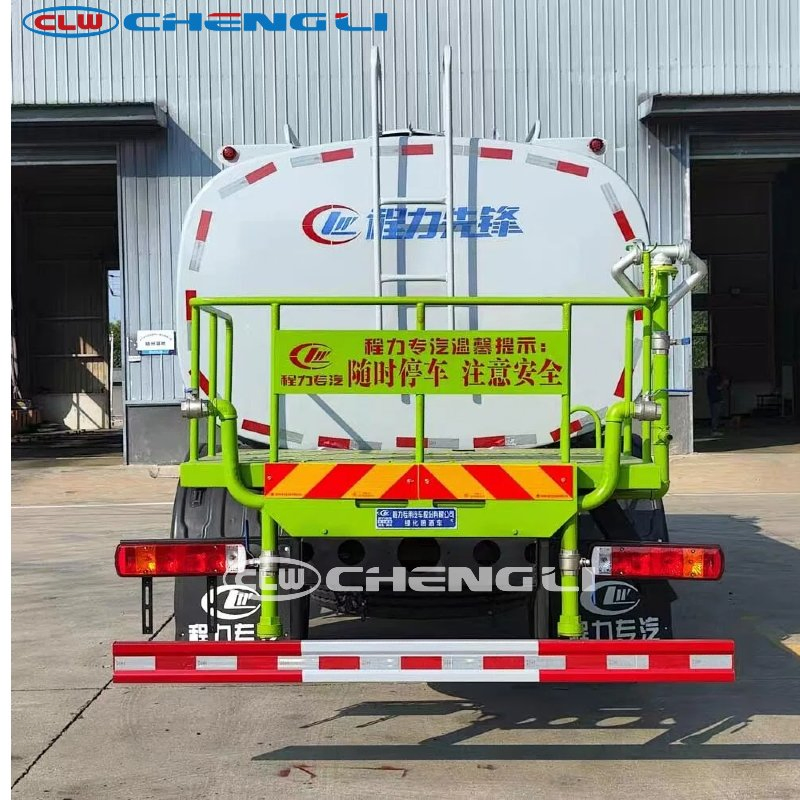
Water delivery splits cleanly into two distinct build specifications. Road-building contractors and estate developers run carbon-steel water bowser trucks—such as the Dongfeng multi-purpose water tanker—with epoxy internal coating, front duckbill sprayers, and rear cannons for dust control and concrete curing. Commercial drinking-water suppliers in Abuja, Lekki, and Tema, however, require food-grade 304 stainless-steel potable water tankers with sanitary manways and stainless centrifugal pumps so water remains odour-free and compliant with health inspections.
Construction Tippers and Heavy Haulage Durability
Quarrying in Ogun State, road rehabilitation along the Lagos–Ibadan corridor, and real-estate earthworks around Accra place extreme torsional stress on dump trucks. A lightweight U-shaped highway body bends quickly under wet laterite and granite boulders. Experienced contractors specify a heavy-duty construction tipper truck—like our 6x4 reinforced dump truck—with an 8 mm floor plate, 6 mm side walls, and a front-mounted Hyva-type telescopic hydraulic cylinder rather than an underbody scissor hoist, which is harder to align on uneven tip sites.
Tyre choice matters just as much as steel thickness. All-steel 12.00R20 tube-type tyres remain preferred over tubeless 315/80R22.5 in up-country Nigerian and Ghanaian operations because roadside vulcanisers can patch tubes and swap split rims quickly without bead-seating machines.
Apapa, Tin Can Island, and Tema Port Clearance Realities
Shipping a well-engineered truck is only half the job; port demurrage at Apapa or Tema can erase a project's margin if documentation is misaligned. Nigeria requires SONCAP certification (Product Certificate followed by SONCAP Certificate) alongside Form M and PAAR processing, while Ghana requires ICUMS valuation, Conformity Assessment documentation where applicable, and strict verification of chassis VIN and engine serial numbers against the Bill of Lading.
Port & Market | Drive Side | Key Pre-Shipment Docs | Preferred Shipping Mode |
|---|---|---|---|
Apapa / Tin Can Island (Nigeria) | LHD | Form M, SONCAP (PC + SC), Commercial Invoice, B/L | Ro-Ro vessel for intact special trucks |
Onne Port (Nigeria) | LHD | SONCAP, PAAR, Oil/Gas project exemption if applicable | Ro-Ro or breakbulk for oilfield units |
Tema / Takoradi (Ghana) | LHD | ICUMS docs, Packing List, Certificate of Origin, B/L | Ro-Ro direct or 40HQ SKD for small chassis |
Before vessel loading in Shanghai or Tianjin, we verify that stamped VIN plates, engine plaques, and axle weights match the proforma invoice to the exact digit. Buyers preparing their first direct import should cross-check our export documents and pre-shipment inspection checklist, our destination port clearance guide, and CLW's global shipping and Ro-Ro delivery process. We also pack a dedicated fast-moving spare kit—filters, belts, hydraulic seals, PTO switches, and brake linings—inside the cab or toolboxes under our warranty and spare parts support programme so trucks begin earning revenue immediately after port release.
Common Regional Buying Questions
Should I order Euro 2, Euro 3, or Euro 4 trucks for Nigeria and Ghana?
For commercial and municipal fleets operating outside dedicated ultra-low-sulphur depot networks, Euro 2 or Euro 3 remains the safest choice. Mechanical fuel systems tolerate regional diesel sulphur levels and allow local workshops to service injectors and fuel pumps without waiting for imported electronic sensors.
Is Ro-Ro shipping better than containerised delivery for Apapa and Tema?
Yes, for complete special trucks such as compactors, fuel tankers, water bowsers, and 6x4 tippers, Roll-on/Roll-off (Ro-Ro) shipping avoids dismantling the superstructure and cuts port reassembly risk. Container shipping (40HQ or flat-rack) is only economical for compact 4x2 chassis or semi-knocked-down (SKD) kits shipped to local assembly yards.
What tank steel thickness is recommended for West African fuel and water bowsers?
We recommend a minimum of 5 mm Q235 carbon steel for the tank shell and 6 mm for end heads on 10,000–20,000 litre fuel and industrial water tankers. Internal wave-breaker baffles should be spaced every 1.2–1.5 metres to protect mounting brackets on potholed roads.
Can CLW supply custom hydraulic fittings and spare parts with the truck?
Yes. Every West African order can include a tailored two-year consumable package—fuel and oil filters, Racor elements, hydraulic hose assemblies, tailgate seal strips, and brake shoes—packed securely with the vehicle so your fleet avoids downtime during initial deployment.
Planning a municipal sanitation, fuel distribution, or construction fleet for Nigeria or Ghana? Browse our complete special purpose truck catalogue, read more regional fleet guides in CLW Market Insights, or send your route and payload requirements via request a factory quote or our export sales desk for a port-ready LHD specification.
Discuss your truck requirement
Share your working task and destination with the CLW team.
Build Your Enquiry